It is no secret that many Tarnished adventurers have vented their frustration over encountering what feels like the same colossal space horror twice in the Lands Between. Why would FromSoftware take one of the game’s most visually striking and unnervingly beautiful creatures and duplicate it? The answer, as is often the case in Elden Ring, is not mere laziness – it is buried deep in the lore, hinting at a grander cosmic mistake the Nox once made.
 .jpg)
.jpg)
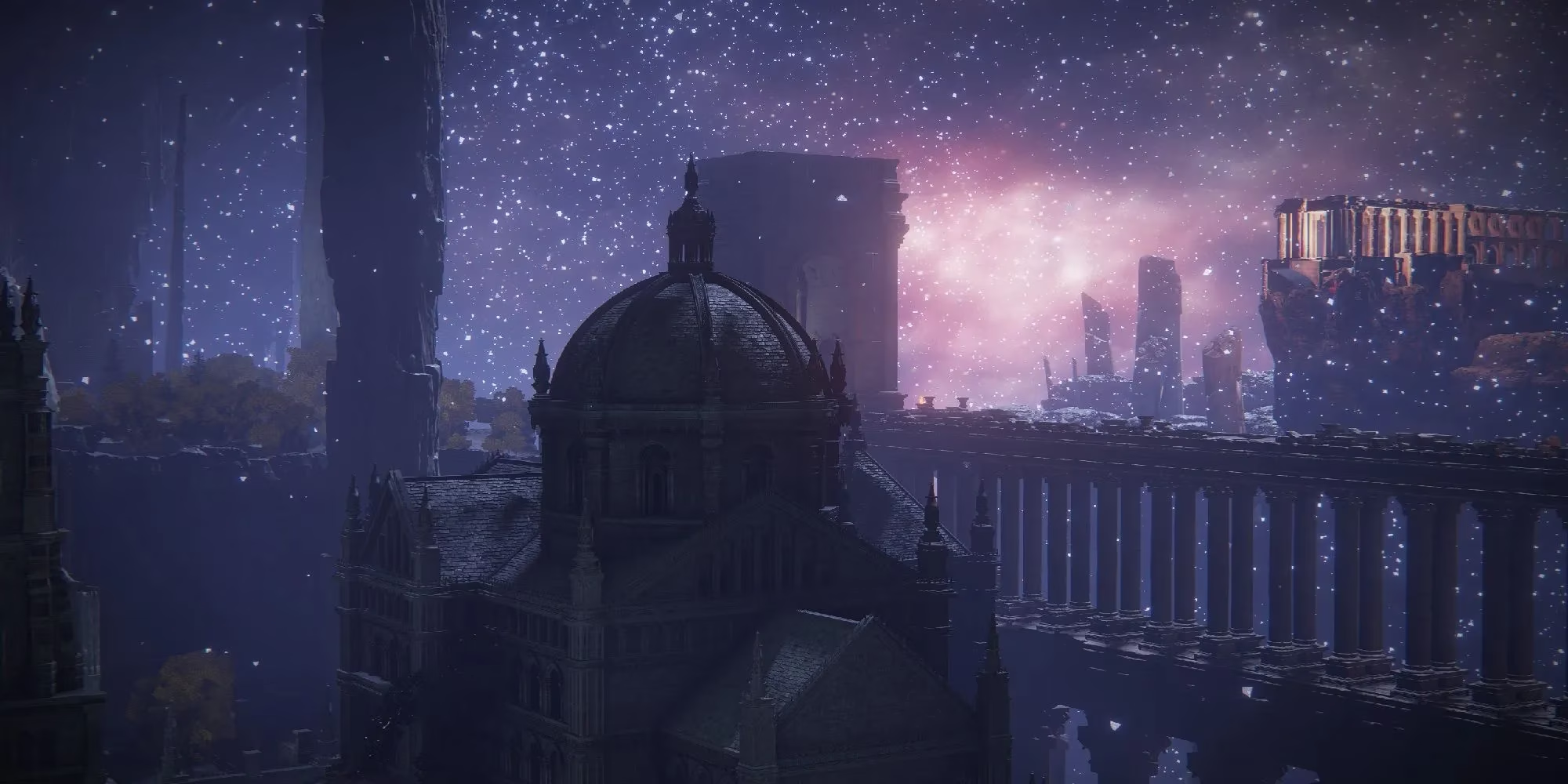
Both Astel, Naturalborn of the Void and Astel, Stars of Darkness are optional super-bosses. One waits in the eerie Grand Cloister beneath the Lake of Rot, a mandatory stop for anyone determined to complete Ranni’s questline and unlock the Age of Stars ending. The other lurks far later in the game, inside the freezing Yelough Anix Tunnel at the Consecrated Snowfields. Already you start to see a pattern: one is tied to an ancient eternal city, and the other to a remote, frozen wasteland that feels just as forgotten. Why are they so far apart yet so similar?
A popular early theory connected these malformed stars to the Fallingstar Beasts. Players can find several Fallingstar Beasts across the world, from a crater in Limgrave to the summit of Mt. Gelmir, and the implication is that Astel is the fully grown, end-stage metamorphosis of those rock-hided, gravity-controlling beasts. That idea works beautifully for the Astel found in the Yelough Anix Tunnel – an icy cave that fits perfectly as a cocoon-like lair. However, for Astel, Naturalborn of the Void, the remembrances and sorceries tell a different, more desperate tale.
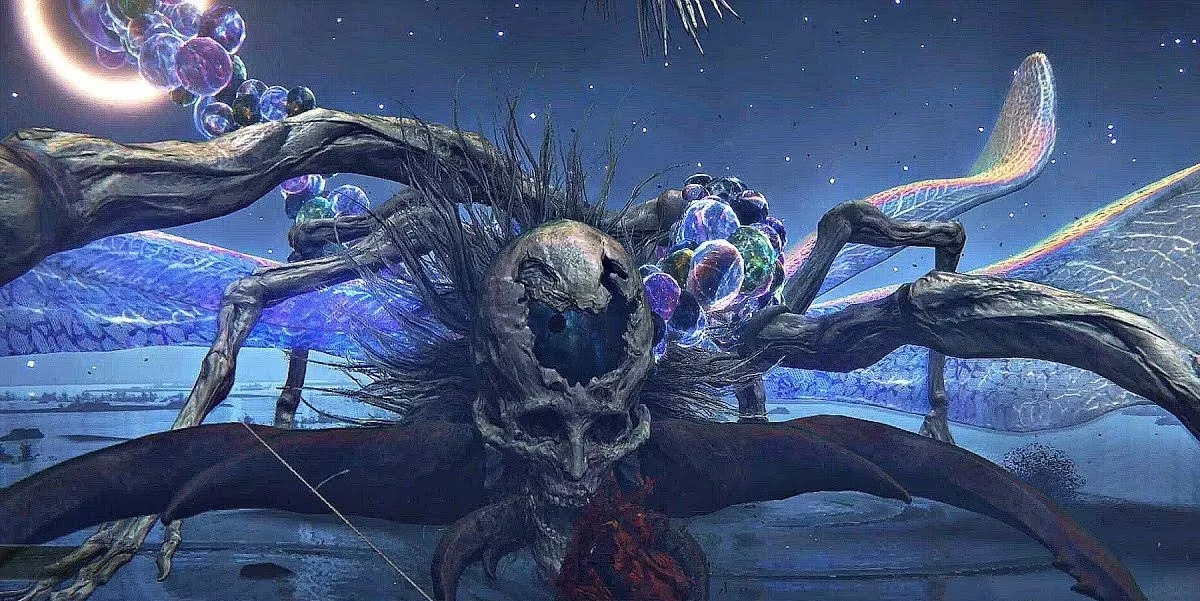
The Remembrance of the Naturalborn outright states that this Astel was born in a lightless void far away. It arrived as a malformed falling star, assaulted an Eternal City, and stole its sky. That phrasing alone – “born in a void far away” – sounds less like a natural metamorphosis and more like something that was pulled into the world. And pulling things into the world is exactly what the Nox, the inhabitants of those Eternal Cities, were dangerously good at.
The Nox had long provoked the ire of the Greater Will. In their clandestine rebellion, they crafted silver tears, attempted to forge an Elden Lord of their own, and wielded dark sorceries that manipulated space itself. The sorcery Eternal Darkness is described flatly as the “cause of the city’s ruin.” Casting it creates a sphere of shadow that drags in other sorceries and incantations. If you stare at the names hard enough – Naturalborn of the Void and Stars of Darkness – a chilling picture emerges. Both Astels share a raw connection to darkness and the void. Perhaps the Nox, in their reckless experiments with Eternal Darkness, did not just create a defensive spell. They may have unwittingly punched a needle-sized hole into the featureless deep of space and pulled not just one, but multiple of these beings through. That would explain why two separate Astels look nearly identical: they are siblings or even the same kind of entity, dragged accidentally into the Lands Between in a single catastrophic event.
What about the power differences? Players who have fought both know very well that Astel, Naturalborn of the Void is usually the harder encounter. It is a true skill check on the way to the Moonlight Altar. That version can summon waves of darkness, unleash a barrage of meteors that seem to come from another dimension, and snatch you with a telekinetic grab that deals massively scaling damage. Then there is Stars of Darkness, found much later in the game. By the time you stumble into its cave, your character is often over-leveled and the fight feels surprisingly manageable. Yet Stars of Darkness does have one terrifying trick the Naturalborn lacks: the ability to create a swarm of phantom copies that all teleport and attack simultaneously. It is a more chaotic, if less punishing, spin on the same moveset.
Some cynics in the community till this day – and it is now 2026 – will insist that the dual Astel is nothing more than a glorified asset flip, much like the multiple Erdtree Burial Watchdogs or repeated Ulcerated Tree Spirits. Elden Ring certainly does not shy away from reusing bosses. But the placement and the naming of these two stars feel too deliberate. You fight the Naturalborn of the Void as you descend deeper into the world’s most cursed underground. You face the Stars of Darkness in the frozen, high-altitude Consecrated Snowfields, an area already brimming with cosmic horrors like the wandering mausoleums and ancient pilgrimage sites. The thematic contrast hints that the Astel species, if you can call it that, spreads wherever the influence of the Greater Will is weak, and where the Nox’s old meddling still echoes.
Years have passed since the base game launched. The Shadow of the Erdtree expansion dived deeper into Miquella’s journey but left the void-touched star beasts as mysteries. Lore hunters have combed through every item description in patch 1.12 and beyond, yet no direct link between the Grand Cloister and Yelough Anix appears. That silence feeds the imagination. Did the Nox’s cataclysmic spell summon an entire cluster of these beings, with the two we encounter being the only survivors? Or is Astel, Stars of Darkness a younger, less developed entity that crawled northward to grow cold and distant, just like the forgotten snowfield itself?
Ultimately, whether you see the two Astels as a cost-saving measure by the developers or a carefully crafted narrative echo, fighting them remains a spectacle. The heavy music, the starry arena, and the grotesque elegance of a skull-faced dragonfly made of space bones never get old. Next time you crush that final health bar and claim the Remembrance of the Naturalborn, spare a thought for the Nox. Their arrogant reach into an unfathomable void may have given us not one, but two of the most haunting bosses the Lands Between has to offer. And who knows – with the Lands Between still holding secrets even in 2026, a third Astel might be hiding just beyond the reach of our current map.