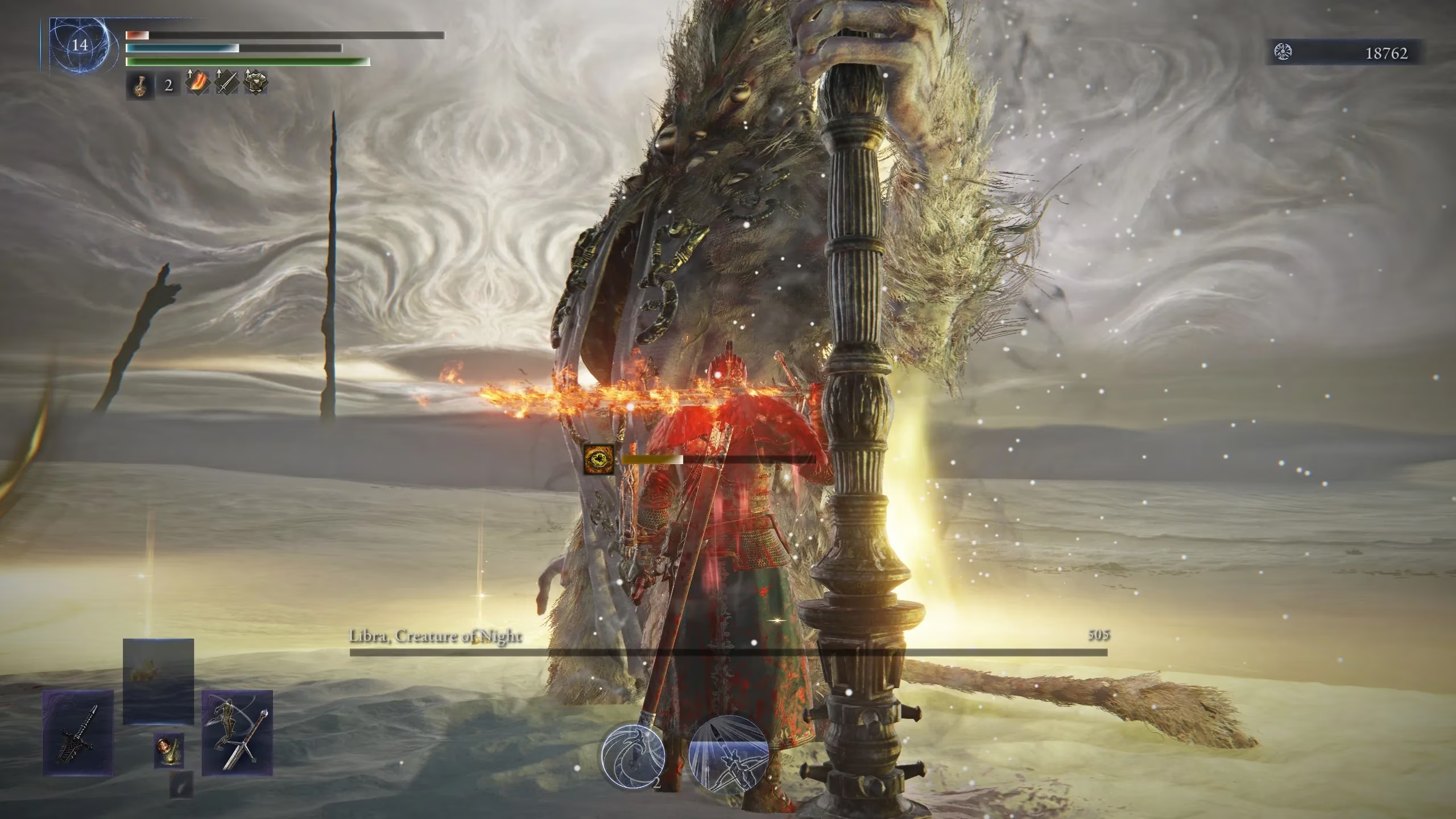
Spoilers for Everdark Libra follow. By 2026, the Nightreign community had settled into a comfortable rhythm: the roguelike spinoff was a co-op game first, a duos experiment second, and a solo challenge third. The old FromSoftware handshake — summon phantoms, split aggro, survive — had carried over from Demon's Souls through Elden Ring, where the Mimic Tear became everyone's favorite accomplice. Nightreign's sturdy tripod of three players felt like the intended shape of the experience. Then Everdark Libra arrived and flipped the equation: the superboss version of the dealbroker gets harder, not easier, as the party grows.
The Handshake Breaks
One solo runner took the boss down after three attempts. The same Tarnished needed more than fifteen tries in duos and trios and still had no win. That inversion became the talk of the community. Some critics argued that Everdark Libra was certain to be nerfed; others, like the stubborn veterans who had learned to love Everdark Augur, insisted that the fight was beautiful precisely because it was hostile.
The base Libra had already been a piece of work. Tied with the end boss Heolstor as the hardest encounter in Nightreign, he threw unusual, difficult-to-read projectile attacks that built up madness. The status effect dealt huge damage and a stun if the victim survived the initial burst. His signature move was a delayed blast sigil: fast enough to catch a player mid-animation, delayed just enough to punish a panic roll. It was deliciously evil, and it taught the party to respect silence.
A Gallery of Evil Twins
Everdark Libra escalates by summoning invader clones of the player party. Each clone carries the same abilities and a weapon loadout chosen to inflict maximum frustration. The roster reads like a nightmare draft of Nightreign's classes:
-
🗡️ Mini Malenia Executor: wields the Hand of Malenia and can perform a weaker but still potentially instant-death version of Waterfowl Dance. Yes, that Waterfowl Dance.
-
🛡️ Terminator Ironeye: carries the Jar Cannon and One-Eyed Shield, plus a seemingly permanent buff like the Ironjar Aromatic. He walks slowly, tanks everything, and refuses to be interrupted.
-
🏹 Sniper Wylder: spams Rain of Arrows from a greatbow, dealing crazy damage in a huge area from long distance.
-
🗡️ Rot Duchess: dual-wields Scorpion's Stinger daggers for fast Scarlet Rot buildup.
These clones do not play by the same rules. The Malenia-Executor is especially difficult to interrupt out of his signature move, and every clone can dodge-roll out of attack combos that a normal player could not. They are not mirrors; they are exaggerations.
The Spawn Timer Is the Real Boss
The crowning touch is how the clones shuffle in. Everdark Libra does not appear to have a consistent timer for summoning a fresh wave. Wiping them out is no guarantee of breathing room to damage the boss. More often, old clones pile up as new ones spawn, and the arena becomes a field of golden buffs and overlapping attack patterns.
The final indignity is that summoning a new wave heals any surviving invaders and buffs their defense and damage. Those buffs stack. A veteran six rounds deep Executor spamming Waterfowl Dance is who one player wished they were playing as. Meanwhile, Libra keeps flinging new, more aggressive madness-inflicting area attacks. A mature Everdark Libra fight is pure chaos: evil clones glowing gold with layered buffs, some attacking each other, but most chasing the party around while Libra turns the field into a bullet-hell screen.

Solo Becomes the Quiet Path
Whether fully intentional or not, FromSoftware's classical deferred difficulty system works in reverse with Everdark Libra. If the enemy draws strength from the party, make the party smaller. One evil twin is far more manageable than triplets, and the singleplayer mode's adjusted health values mean clones go down quicker too. Even in failed solo runs, the chaotic pileups of a three-player slugfest rarely appeared.
| Party size | Clone pressure | Healing and buff stacking | Overall feel |
|---|---|---|---|
| Solo | One clone at a time | Low | Tense but readable |
| Duos | Two clones | Medium | Messy |
| Trios | Three clones | High and stacking | Beautiful nonsense |
That table is not a complaint. It is an observation about a boss that rewrites the co-op covenant. Nightreign had already been a game about trios; Everdark Libra made the solo queue feel like the secret expert route. The inversion is another example of how flexible and surprising FromSoftware's well-worn systems can still be. After Promised Consort Radahn in Shadow of the Erdtree, some players worried that the studio's arms race with itself had hit a ceiling. Everdark Libra suggests there is no ceiling, only new angles.
A Curveball Worth Keeping
The fight is also a joke at the player's expense, a prank played with golden clones and stacked buffs. That is one of the rarest pleasures in a game, and FromSoftware remains a master of it. Could the clone spawns be eased just a touch? Maybe. Is it somewhat unfair that Vyke's War Spear, the only melee weapon Libra is weak to, is such a rare drop that one long-suffering Tarnished had seen it only twice in 111.8 hours? Perhaps.
None of that changes the verdict. Everdark Libra is stupid, mean-spirited, and utterly hilarious. He is the kind of boss that makes a party laugh before it makes them scream. In 2026, as Nightreign players continue to argue over nerfs, the superboss stands as proof that FromSoftware can still deliver spectacles, challenges, and sheer curveballs that nobody sees coming. The best response is not to soften him. It is to adjust, bring fewer friends, and learn to love the chaos.