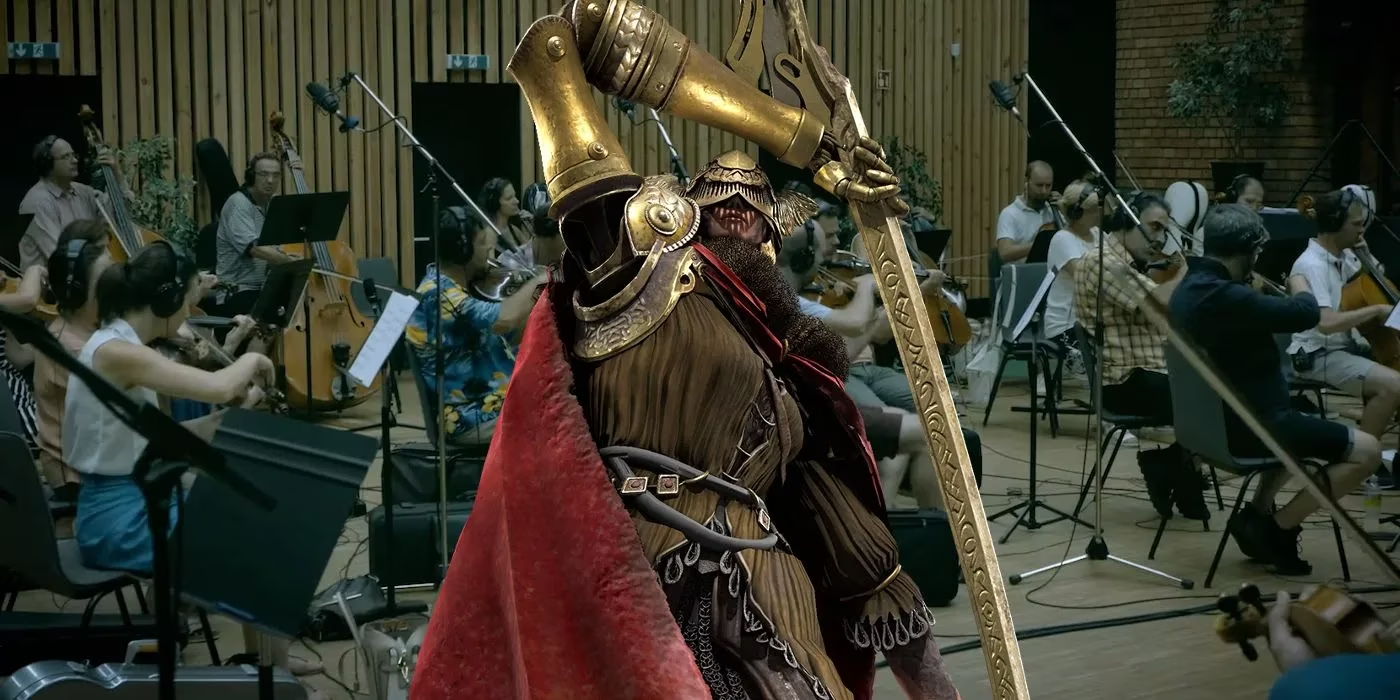
The Budapest Film Orchestra bows its strings, and suddenly a Tarnished soul halfway across the world shivers in recognition. That haunting swell isn’t just music — it’s a living, breathing entity that has crawled out of the Lands Between and taken up permanent residence inside the eardrums of millions. As of 2026, the Elden Ring original soundtrack has been streaming everywhere for over three years, and yet one track still sends its own creator into a quiet, emotional spiral. Tsukasa Saitoh, the composer behind many of the game’s most memorable cues, recently let slip his deep, almost parental affection for the title theme, “Elden Ring.” Not a boss theme. Not the Regal Ancestor Spirit’s melancholic lullaby. The title screen. The piece that plays before anyone even grazes a controller.
Now, let’s be real — in the Soulsborne universe, silence is the true opening act. Players wander through vast, terrifyingly quiet landscapes, the only soundtrack being their own frantic heartbeat and the clank of ill-advised armor. Then a fog gate appears, and BAM — a choir kicks in like a vengeful opera ghost. FromSoftware has spent decades perfecting this musical ambush, but the title theme has a far tougher job: it must greet a player who hasn’t even pressed “New Game” yet and convince them, yes, you will die 400 times and love it. Saitoh’s confession, shared via a PlayStation Blog post celebrating the OST’s streaming release, reveals that this piece demanded obsessive fine-tuning. “We spent a long time obsessing over and fine-tuning the details and tonal qualities of this piece,” he said, “and I think as a result we achieved something that embodies the themes of the game, and became a strong directional pillar for the rest of the music.” Translation: the team basically had a musical staring contest with the title theme for weeks, and the title theme won — but in the best possible way.
The Maestro’s Emotional Anchor
Saitoh doesn’t just admire the title theme; he describes it as the piece he’s “most emotionally attached to.” For a game that boasts a boss roster longer than a dragon’s tail, that’s a bold statement. After all, players have been emotionally scarred by the shrieking violins that accompany Malenia’s waterfowl dance, or the thunderous percussion of Radahn’s meteor entrance. Yet here sits a simple, majestic overture, holding the entire game on its shoulders without ever raising its voice to a scream.
What makes the title theme so special, according to Saitoh, is its need to “represent the game in its entirety” and “express something different to our previous titles.” No pressure, right? The piece had to be an elevator pitch for a 100-hour odyssey, all in under two minutes. It had to whisper of shattered rings, golden trees, and a very grumpy Elden Beast without spoiling a single frame of the actual adventure. The composers essentially gave the theme a personality — part curious wanderer, part doom-laden prophet. You can almost hear the music mutter, “Get comfortable, Tarnished. It’s going to be a long, gorgeous nightmare.”
To achieve this, Saitoh and fellow veteran Yuka Kitamura (whose name is synonymous with Soulsborne boss battle grief) layered strings that swell like a sunrise over Limgrave, horns that echo the grandeur of Leyndell, and a subtle choir that feels less like angelic salvation and more like a flock of ominous pigeons sizing you up. The Budapest Film Orchestra, captured in that image above, gave the score a cinematic texture that makes even the main menu feel like a pilgrimage. And honestly, no kidding — many players have confessed to letting the title screen play on a loop just to soak in the vibe before inevitably being flattened by a Tree Sentinel.
Why Title Themes Steal the Spotlight
Title themes in video games often have an unfair advantage: they arrive when the player is at peak anticipation. No one is rage-quitting, no one is scrambling for a flask. The brain is a clean slate, and the music has the rare chance to implant itself directly into memory without competition from screaming trolls. Saitoh understands this unenviable yet powerful position. “I think we made a good piece for when players start up the game,” he said, “stirring their motivation and excitement for heading out on their adventure to become Elden Lord.”
Let’s put that statement under a microscope for a moment. The man is being modest. That piece doesn’t just stir motivation — it shoves a whole war drum into the soul. It’s the musical equivalent of a horse kicking you into a painting while a grandparent tells you you’re destined for greatness. Many Elden Ring veterans will admit, through tear-streaked faces, that the title theme now triggers instant nostalgia. It’s Pavlovian: hear the first note, and suddenly you’re back at the Roundtable Hold, arm-wrestling a spectral blacksmith.
Compare this to some of the game’s boss themes, and a curious pattern emerges. Boss music operates on shock value — it needs to amplify the immediate threat, the panic, the awe. The title theme operates on slow-burn poetry. Here’s a quick breakdown in table form, because why not:
| Track Type | Emotional Goal | Player Reaction | Saitoh’s Attachment |
|---|---|---|---|
| Title Theme | Inspire, world-build, comfort | “I am the Elden Lord, watch me!” | Overwhelming |
| Boss Theme (e.g., Godrick) | Intimidate, energize, dramatize | “OH NO OH NO OH NO” | Professional pride |
| Ambient Overworld | Isolation, tension, calm | “Is that a sheep or a rune bear?” | N/A (silence mostly) |
See? Title themes are the emotional long game. They don’t need to scare the living daylights out of anyone; they just need to plant a flag in the heart and quietly say, “I’ll be here when you return, hero — probably after 40 more attempts at the Fire Giant.” \ud83e\udd86\u200d\ud83d\udd25
The Orchestra That Breathed Life into the Notes
That Budapest Film Orchestra photo isn’t just for show. In 2026, with the soundtrack readily available on Spotify, Apple Music, and probably every streaming platform that hasn’t been devoured by a cosmic serpent, the performance still stands as a testament to how seriously FromSoftware takes its audio. Live orchestration added a warmth and unpredictability that sample libraries can’t fully replicate. Each string vibrated with the weight of a thousand Tarnished dreams. Even the brass section seemed to understand that they were heralding the end of an age.
And hey — word on the spectral street is that the orchestra was given the brief to “sound like the Erdtree would be proud.” Whether that’s true or just a meme that escaped from the Roundtable, the result speaks for itself. The title theme sounds like sunlight breaking through a fog of pure dread, a motif that carried throughout the entire score and trickled into Kitamura’s boss compositions like a shared secret among friends.
What Lies Ahead for the Music of the Lands Between?
As of 2026, whispers of a new FromSoftware project are rustling through the community like leaves in a perpetually wind-swept realm. Details are scarcer than a friendly NPC, but one thing is certain: the studio’s audio department will once again be asked to perform miracles. Saitoh’s reflection on the Elden Ring theme hints at a deep well of creative philosophy that won’t dry up anytime soon. If a title screen track can be so meticulously crafted that its composer gets misty-eyed years later, imagine what comes next.
The current streaming availability means players can now carry that weight in their pockets, letting the title theme soundtrack morning commutes, gym sessions, or moments of existential dread when facing a difficult email. It’s a strange, wonderful thing when a piece of art designed for a fictional apocalypse becomes a comfort blanket for modern life. So next time that main menu loads up and the strings begin their ascent, spare a thought for Tsukasa Saitoh — the man who spent ages obsessing over tonal qualities so you could feel like a legend before you’ve even chosen your starting class.
And let’s be honest: a tune that can make waiting for a loading screen feel epic deserves all the emotional attachment in the world. \ud83c\udfb5