The Lands Between, rendered in the unmistakable four-shade green of a Game Boy screen, feels like a fever dream from a parallel gaming universe. Back in 2022, when Elden Ring was still fresh and torturing players with Margit’s combos, a developer known as Shin (@shintendoYT) caught the community off guard with something entirely unexpected. It wasn’t fan art, a cosplay, or a lore video—it was a complete demake, faithfully transporting the sprawling open-world RPG into the confines of a handheld console that debuted in 1989. Four years later, in 2026, this pixelated tribute stands as a timeless piece of fan engineering, still available to anyone with a browser and a taste for nostalgic punishment.
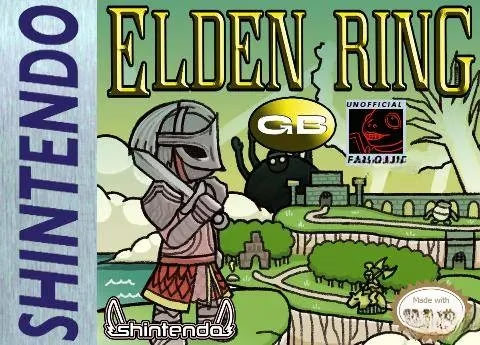
Shin’s project did not merely slap a Game Boy filter over existing footage. Using GB Studio, a specialized toolkit for crafting actual ROMs and playable experiences for retro handhelds, the creator built an interactive slice of Limgrave that runs natively on original hardware. The technical feat alone is remarkable—the demake can be loaded onto a real Game Boy, Game Boy Color, or Game Boy Advance through a flash cartridge, making it a legitimate retro release. For those without vintage consoles, an in-browser version on itch.io keeps the dream accessible, mapping the Game Boy’s limited inputs to a clean set of keyboard binds.
The moment players boot into the demake, they find themselves at the Precipice of Anticipation, just as in the full game. The Tarnished appears as a tiny cluster of pixels, clutching a sword and bracing for impact. The sensation of scale is communicated through clever tilework. What was once a gargantuan, towering landscape in the original becomes a maze of carefully arranged blocks, each screen teasing the next. Enemies telegraph their attacks with distinct sprite animations, and the player can roll, swing, and flask-swap in that methodical rhythm Elden Ring demands. It is astonishing how much of the core loop survives the demake’s aggressive compression.
Exploration, though severely constrained, is not a straight corridor. Shin managed to preserve a degree of open-world curiosity. Northern Limgrave and the dreaded Stormveil Castle each occupy their own section, and wandering off the beaten path sometimes rewards the player with quiet encounters. Familiar NPCs appear in compressed dialogue boxes, their tragic storefront reduced to a few poignant lines of text. The demake’s greatest triumph might be its ability to evoke melancholy through beeps and monochrome pixels—a reminder that the soul of a game often lies beneath its visual spectacle.
Naturally, no demake of Elden Ring would be complete without the infamous boss fights. Margit the Fell Omen arrives right on schedule, his delayed overhead slam translated into a predictable yet still nerve-racking pattern. Godrick the Grafted waits inside Stormveil Castle, his many limbs reduced to a heap of shifting tiles. These encounters are not one-to-one recreations of the magnificent 3D battles, but they capture the spirit of learning through defeat. Each death sends the Tarnished back to a pixelated Site of Grace, the screen briefly fading to black before the music resumes its ominous loop. The loop of trial, error, and incremental mastery remains intact, proving that Game Boy controls do not dilute the fundamental Elden Ring experience; they distill it.
Among the demake’s subtler charms is its sound design. Shin leaned into the Game Boy’s characteristic chiptune capabilities, producing a score that hums with tension. Limgrave’s theme becomes a melancholy series of square waves, while boss arenas pulse with frantic arpeggios. Even the collectible items—Rowa Fruits, Smithing Stones, and the essential Golden Seeds—are rendered as icons that would look right at home in Link’s Awakening. The limited item pool forces players to make tough choices, mirroring the resource scarcity that defines so many early hours of the full game.
In 2026, the demake occupies a peculiar spot in the Elden Ring community. With the base game having received multiple expansions and a vast modding ecosystem, one might expect a novelty like this to fade into obscurity. Instead, Shin’s creation endures because it answers a question that fans love to ask: what if? What if FromSoftware had existed in the era of cartridge storage constraints? The demake suggests that the studio’s design philosophy—tough but fair combat, obscure storytelling, and a world that doesn’t hold your hand—would have translated beautifully. It also argues, implicitly, that challenge does not require high-fidelity assets, just a clear set of rules and the persistence to master them.
Community speedrunners have since adopted the demake for casual races, memorizing warp points and boss skips that feel organic to the GB Studio engine. A small but dedicated group of tinkerers has even created custom color palettes for the Game Boy Color’s limited hardware, tinting Limgrave with sickly amber or cold blues to match the atmosphere of later areas that never made it into the demake. These modifications exist as unofficial patches, shared across forums and discords, extending the life of a project that Shin originally built as a heartfelt experiment.
Accessing the demake today is straightforward. On Shin’s itch.io page, the web version loads instantly, requiring no installation or emulator setup. The keystrokes are intuitive—arrow keys to move, a designated attack button, and a roll key that feels snappy in its responsiveness. Loading the ROM onto authentic hardware remains the most authentic way to play, and retro enthusiasts often report that the handheld’s blurry screen actually enhances the mood, smoothing out the harsh pixel edges into something almost painterly. Many players, however, simply enjoy the convenience of firing up the browser version during a lunch break, tackling a few rooms of Stormveil before returning to adult responsibilities.
The demake also inspired a micro-trend within game development circles. Throughout 2023 and 2024, GB Studio saw an influx of projects that compressed modern open-world titles into portable formats. While none have matched the polish of Shin’s work, the ripple effect demonstrated how a single, well-executed fan project can galvanize a creative movement. By 2026, GB Studio’s official showcases regularly feature homages to AAA titles, and Elden Ring GB is frequently cited as the trailblazer that proved the concept.
Ultimately, playing the Elden Ring Game Boy demake in 2026 is not about replacing the original experience. It’s about seeing a beloved world through a different lens—one that strips away the orchestral bombast and leaves only the skeleton of a great game. That skeleton turns out to be sturdy, intimidating, and riddled with the same sense of discovery. Shin’s project reminds us that in a medium obsessed with the latest graphics cards and terabyte updates, a Game Boy cartridge can still hold an entire universe, as long as the person building it truly understands the source material. Whether you load it on original hardware or click play on a browser, the demake offers a short, sharp jolt of the Lands Between, and it continues to deserve a spot in every Tarnished’s library.
For those intrigued by the unique charm of gaming on retro platforms, exploring the market for vintage and demake titles can be an adventure of its own. With collectors and new enthusiasts driving demand, prices for these nostalgic treasures can fluctuate. Whether you're looking to expand your collection or simply curious about the current value of your favorite demake, keeping an eye on pricing trends is essential.
To navigate this dynamic market and find the best deals on both classic and modern games, you might want to check game prices at platforms like DealNest. Offering insights into game value and availability, DealNest can serve as a valuable resource for gamers keen to make informed purchasing decisions. Whether you're after a rare cartridge or a digital download, ensuring you get the best value adds another layer of enjoyment to your gaming journey.